
What's a Key Signature? A Guide to Identifying the Key of Any Piece
Every piece of sheet music starts with a set of sharps or flats you're expected to read at a glance. Here's what a key signature tells you, and how to read one without memorizing all fifteen.


A key signature is the group of sharp or flat symbols placed at the start of every staff line, right after the clef. It tells you which notes to raise or lower for the rest of the piece so the composer doesn't have to mark every accidental by hand.
Here's where to find the key signature, how to use it, and how to identify one without memorizing all fifteen.
What Sharps and Flats at the Start of the Piece Are Really Telling You
You open a piece of sheet music and see a series of sharps or flats right after the clef. Before you play a single note, those accidentals have already told you which notes to consistently raise or lower for the entire song, so you don't have to think about it note by note.
For example: two sharps in the key signature mean every F and every C are played sharp, in any octave, until something on the page says otherwise.
Where Does a Key Signature Appear on the Staff?
A key signature sits between two other symbols:
- The clef, which fixes pitch names to the staff lines
- The time signature, the stacked numbers that set the rhythm
It appears once at the start of the piece, then again at the beginning of every new line for as long as it applies.
This is very important. If you're reading down a page and a new line starts, the key signature is right there again, so you don't have to look at the beginning to remember which notes are altered. Skip past it on a new line and you may misread notes for the rest of that line.
What Do Sharps and Flats in a Key Signature Do?
Each sharp or flat in a key signature applies to every note of that letter name, in every octave, for the rest of the piece, unless an accidental (a sharp, flat, or natural placed next to a specific note) cancels it for that measure.
Example: G major (one sharp — F#)
If a melody has an F in the treble staff, and another F an octave higher later in the same line, both are played sharp. Neither note gets its own sharp sign written next to it. The key signature already covers it.
This detail can be confusing for new readers: the sharp in the key signature isn't tied to one F on one line of the staff. It governs the letter name, wherever it shows up.
How Are Key Signatures Organized?
Sharps and flats aren't added at random. They follow a fixed order:
| Type | Order Added |
|---|---|
| Sharps | F, C, G, D, A, E, B |
| Flats | B, E, A, D, G, C, F (exact reverse) |
That fixed order is why key signatures can be reasoned out instead of memorized as fifteen unrelated shapes. The circle of fifths is the standard tool for seeing this pattern. Moving clockwise around it adds one sharp or removes one flat, in that same order.
How Do You Read a Key Signature Without Memorizing All Fifteen?
Two shortcuts and two exceptions cover most of what you'll run into:
| Key Type | Shortcut |
|---|---|
| Sharp keys | Find the final (rightmost) sharp in the key signature, then go up a half step. That note is the name of the major key. (e.g., two sharps ending in C# = D major) |
| Flat keys | Find the penultimate (second-to-last) flat. This note is the name of the key. (e.g., three flats: Bb, Eb, Ab = Eb major) |
| One flat (exception) | Always F major — the shortcut doesn't apply, so this one's worth memorizing |
| No sharps or flats (exception) | C major (and its relative minor, A minor) |
Disclaimer: These shortcuts will help you cover the vast majority of keys. For signatures you see less often, like B major or Db major, a key signature chart and memorization reference is faster than working it out by hand every time.
Here's a quick-reference chart of all 15 major and minor keys and their signatures:
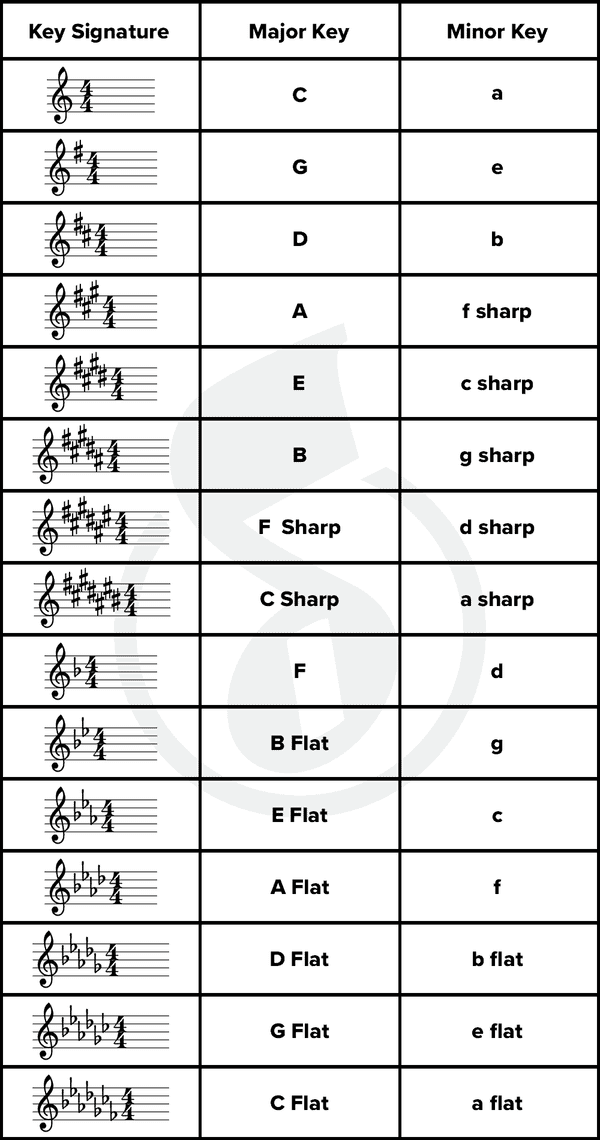
Keys with more sharps or flats aren't harder to play, they're just slower to sight-read at first, because you see them less often and the note names haven't become automatic yet. That gap closes with repetition, not only memorizing more symbols.
Can a Key Signature Change in the Middle of a Piece?
Yes. This is called a modulation: a shift to a new tonal center for a section, or for the rest of the piece.
When it happens:
- The old key signature is canceled, often with natural signs
- The new key signature is written in as if the piece is starting over with a fresh set of rules
This often shows up in longer classical works, and in songs with a key change in the final chorus. If the sharps or flats suddenly change partway down the page, that's not a printing error, it's a real shift in the piece's harmonic center. See key changes within a piece for why it happens musically.
How Do Key Signatures Relate to Major and Minor Keys?
Every key signature belongs to two keys at once: a major key and its relative minor, sharing the same accidentals but centered on a different note.
- No sharps or flats = C major or A minor
- One sharp (F#) = G major or E minor
- One flat (Bb) = F major or D minor
That's why the key signature alone can't tell you if a piece is major or minor. Two pieces can share the exact same key signature and sound completely different: one bright and resolved, the other darker and more restless because the tonal center (the note that feels like "home") is different.
Figuring out which one you're actually in is a separate skill: identifying major and minor keys.
Key Signature vs. Time Signature: What's the Difference?
They sit next to each other on the staff, but they answer different questions:
| What It Tells You | |
|---|---|
| Key signature (sharps/flats) | Which notes to alter |
| Time signature (e.g., 4/4, 3/4) | How the beats are grouped |
They always appear in the same order on the staff: clef, then key signature, then time signature. Mixing up the order of these two is a common early mistake.
Put It Into Practice
Before you play a new piece, try this:
- Check the sharps or flats in the key signature
- Work out the key using the shortcuts above
- Confirm whether it's major or minor by determining where the piece resolves
Doing this on every new piece is what makes reading key signatures automatic, and it's a habit worth building before you sight-read anything more advanced. If you're looking for pieces to practice this habit, browse sheet music by skill level to find something in a key you're working on.
Frequently Asked Questions
What is a key signature in simple terms?
A key signature is the group of sharps or flats at the beginning of a staff line. It tells you which notes to play raised or lowered for the whole piece, so the composer doesn't have to mark every individual note.
How do you find the key from a key signature?
For sharp keys, the name of the key is one half step above the final sharp. For flat keys, the second-to-last flat names the key directly. When there's only one flat, that is F major. Confirm by checking whether the piece resolves to that note's major key or its relative minor.
Can a key signature change in the middle of a song?
Yes! That's a modulation, a shift to a new tonal center for a section or the rest of the piece. The new key signature is written in wherever the modulation happens, often preceded by the appropriate accidentals to cancel the old one.
Do I need to memorize all 15 key signatures to identify the key of a piece?
Not necessarily. Understanding how to read a key signature and apply the sharp and flat shortcuts will get you through most songs. Full memorization comes naturally with repetition.